Burial Of Mrs Napier

GLASGOW HERALD FRIDAY 29 OCTOBER 1875

THE LATE MRS NAPIER OF SHANDON

Yesterday, shortly after noon, the remains of Mrs Napier, wife of Mr Robert Napier, of Shandon, were committed to their last resting place in the family vault in Dumbarton Churchyard. The deceased, who had attained the ripe age of 83 years, died at Shandon on the 24th inst. [meaning of this month].
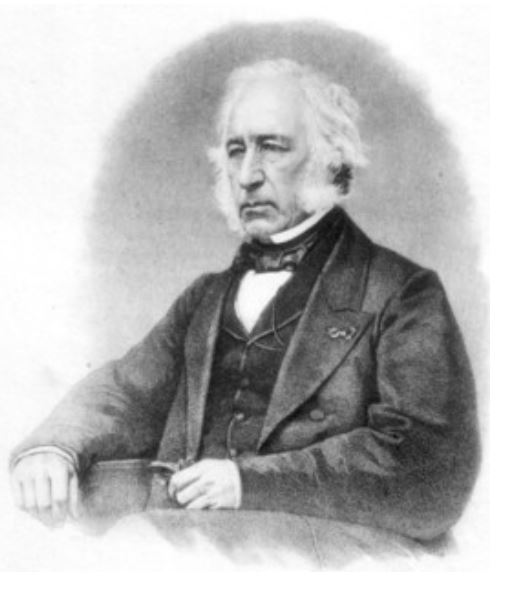
Robert Napier

Like her husband, she was a native of Dumbarton, being a daughter of the late John Napier, who at one time carried on the business of iron founder and blacksmith in what was known as ‘the King’s Arms Close’, in High Street, Dumbarton, but who nearly 70 years ago removed to the suburbs of the city of Glasgow, where he continued in business for a long period.

On account of the respect in which the deceased lady was held, there were many traces of a general sorrow in the town, flags were drawn up half-mast high, and the bell of the parish Church was tolled for some time both before and after the interment. The body was conveyed from Shandon in a hearse drawn by four horses, and the cortege, as it passed along High Street to the Old Churchyard, was witnessed by a large number of people, who lined the streets on both sides.

Amongst the relatives present at the funeral were:- Mrs Hastie, Carnock, Dunfermline, and Mrs Wilkie, London, daughters of the deceased; Mr Jas. R Napier and Mrs Napier, Blythswood Square, Glasgow; Messrs John Napier, Saughfield, Glasgow; William Napier, Hillhead, Glasgow; James S Napier, Woodside Place, Glasgow; J W Napier, Renfrew Street, Glasgow; John Napier, Inveraray; R B Napier, Govan; John D Napier, Glasgow etc.

It is now about twenty years since any interment took place in Dumbarton Churchyard, it having been closed against burials for that period by order of the Sheriff, after a full public enquiry, but the family vault in which the body of Mrs Napier was placed yesterday, and which is situated at the extreme back of the Churchyard, was not included in that order.

The Napier family vault

***********************************

Dear blog reader

Just a little extra information, this is the inscription on the Napier family vault:

Robert Napier second son of James Napier & Jean Ewing died at West Shandon on the Gareloch in the year 1876 in the 86th year of his age.

Isabella Napier his wife died at West Shandon in the year 1873 in the 83rd year of her age.

David their fourth son died at Row [Rhu] in the year 1833 in the second year of his age & was buried there.

Robert their third son died at West Shandon in the year 1848 in the 20th year of his age.

Railway Accident at Shandon – part 3

Dear blog reader

This is part 3 of a 3 part series on a railway accident at Shandon in  1895, continuing on from parts 1 and 2 published the previous 2 weeks.

I do hope you find this interesting.

Jacqueline

**********************

GLASGOW HERALD FRIDAY 22 NOVEMBER 1895

THE RAILWAY ACCIDENT AT SHANDON

Major Marindin reports to the Board of Trade on the accident which occurred on the 14th October, at Shandon Station, on the West Highland Branch of the North British Railway. All the three carriages which were derailed were damaged. One passenger was seriously injured and another was shaken.

Shandon Station

Major Marindin says:- I attribute the accident partly to the delay of the signalman at Shandon in going to make the road and lower the signals for the up train, and to his having omitted to restore the points to their normal position after the passing of the down train: and partly to the up distant signal light having been out when the train passed it, and to the leading driver of the train having lost his way.

The evidence of the drivers, taken with that of Inspectors Bell and Davidson, raised the suspicion that the signalman at Shandon did not pay proper attention to his duties in regard to the trimming and lighting of the distant-signal lamps.

This accident furnished an argument in favour of fitting the safety appliances at facing points, so that the locking bar is actuated by the same lever as the points, instead of, as is far more common, by the lever working the bolt lock.

Railway Accident at Shandon – Part 2

Dear blog reader

This is part 2 of a 3 part series on a railway accident at Shandon in  1895, continuing on from part 1 published a week ago, part 3 will be published next week.

I hope you find it interesting.

Jacqueline

***********************

GLASGOW HERALD TUESDAY 15 OCTOBER 1895

RAILWAY ACCIDENTS. ALARMING AFFAIR ON THE WEST HIGHLAND RAILWAY – LADY INJURED.

A PASSENGER’S NARRATIVE.

I was a passenger from Fort William by the 4.20pm train. The night was dark, and the train was going swifter than usual, which made the oscillating sensation more felt than ever.

The train was driven by two engines, and composed of three carriages, two horse boxes, and guard’s van, and about 100 passengers, arranged as follows:- Third-class carriage, first-class carriage, third-class carriage, horse boxes, and guard’s van. All well until nearing the home signal at Shandon Station, and when entering the platform we felt a violent shaking of the carriage. It had left the rails, and was forced partly up the bank.

Shandon Station

There were four of us in the compartment, and we got mixed up on the floor. Some sprang up and caught the luggage rack as the carriage was dragged along, fearing the train was going over the wall, and, expecting to be killed. Various expressions and symptoms of feat were visible.

When we got out we saw the engines had entered the platform on the wrong side, and the first-class carriage which was next us had been dragged along the island platform on its side about 20 or 30 yards, and the bogie wheels torn off. The third carriage had come up, the end being driven in by the contact with this carriage, and otherwise badly smashed up before the train was brought to a standstill.

None of the passengers were badly hurt as far as I could see – which was a miracle – with the exception of a lady, the sister of a medical gentleman, who was with her, from Uddingston.

Railway Accident at Shandon – part 1

Dear blog reader

This is part 1 of a 3 part series on a railway accident at Shandon in 1895, parts 2 and 3 will be published in subsequent weeks.

Hope you find this interesting.

Jacqueline

******************************

GLASGOW HERALD TUESDAY 15 OCTOBER 1895

RAILWAY ACCIDENTS. ALARMING AFFAIR ON THE WEST HIGHLAND RAIlWAY – LADY INJURED.

An alarming railway accident occurred last night on the West Highland Railway near Shandon, Gareloch, which happily was unattended with loss of life, but resulted in considerable destruction of plant.

It appears that the train which leaves Fort William at 4:22 was approaching Shandon Station about eight o’clock when a couple of carriages left the line about six feet from where the double line is formed. One of the carriages went right along on the south side of the platform to opposite the booking-office, when it toppled over onto the side. The carriage immediately following tore up on the platform, and finally rested right across it and over part of the line on the north side.

Shandon Station

There was a considerable number of passengers in the train, and great alarm was felt, but with one exception the passengers escaped with a shaking. One lady named Mrs Gillies, who is staying at Shandon Hydropathic, and had been to Fort William for the day, was rendered unconscious for a time and was injured about the forehead.

Immediately on the accident happening information was sent to Helensburgh, and Mr Purves, stationmaster, at once proceeded to the scene of the accident with assistance. Dr Sewell and Dr Reid were speedily on the spot and rendered help. Mrs Gillies was removed to the stationmaster’s house, which is close at hand, and after receiving medical help was able to be removed to the Hydropathic. So far as can be ascertained at present her injuries are not serious, beyond a severe shock. A train was sent up from Helensburgh about ten o’clock, and took off the passengers.

The breakdown squad from Cowlairs was telegraphed for, and proceeded to the spot without delay. The train consisted of two engines, three carriages, van, and two horse vans. The carriages that left the line are very much damaged, and looking at their position, it seems a marvel how any of the passengers escaped. The permanent way and a portion of the platform are somewhat damaged, and it will take some hours to clear the line.

A special train was made up and sent from Helensburgh about nine o’clock, and took the passengers and luggage on to Glasgow about an hour and a half late. This was the last train for the night, and as the rails were badly twisted, it will cause some delay in the morning.

No correct solution of the accident can be given, but it is thought that the points must have locked or shifted after the engines passed over on to the wrong line, entering the platform on the up line, with the carriages turned on to the down line, thus dividing the train, the engines going one way and the carriages another. The relief train arrived at Upper Helensburgh at 10pm, where some anxious relatives were waiting for their friends, and were much relieved when the train arrived and the passengers comfortably resting as if nothing had happened.

*****************************

Part 2 will be published next week on a passenger’s narrative and part 3 will be published the next week again on the report to the Board of Trade.

Shandon Valuation Roll 1905

Dear blog reader

Welcome to the sixth part in a series, a list of the people, with house names where known, who were connected with Shandon in 1905.

In 1905 Shandon had 82 households listed. A vast increase on the anomaly of the valuation roll of 1895 when  only 16 households were listed but also an increase on the number of households in the 1885 Shandon valuation roll.   In 1885 Shandon had 74 households, a huge increase from 1875 when Shandon had 32 households. The 1875 number was the exact same number as the 32 households in 1865 which had been a growth of 4 households from the 28 households in 1855.

Hopefully those of you with ancestors from Shandon will find this list useful.

************************

Agnes Louisa M Adams, Balernock

William Allan, Chapelburn

David Anderson, Shandon Bank

John Anderson, Linnburn

John Anderson, Ardgare

Miss Bertha F Baines, Altnacoille

John Barr, Linnburn

Albert R Brown, Summerhill

Albert R Brown, Woodside

William Chadburn, Cragmore

James Crichton, Shandon Lodge

Jane Cross, Croy

Frank Dinwoodie, Shandon House

John G Don, Ardgare

Thomas Don, Ardgare

James Donaldson, Ardgare

Robert M Donaldson, Blairvaddick

John Finnie, Woodside

Mrs Catherine Ford, Woodbank

Mrs Catherine Gibson, widow, Greenhill

William Glen, Hillhead

Frederick Godden, Croy

Richard Going, Hillhead

Mrs Mary Grabowsky, Linnburn

Carl Grabowsky, Linnburn

Donald Grant, Agnes Millar Wilson house

William Grieve, West Shandon

Malcolm Hamilton, Ardchapel

Edmund Hanagan, West Shandon

Robert G Hanning, Letrualt

Mrs Frances Chisholm Hartley, widow, Letrualt

Andrew Charles Henderson, Shandon House

Archibald Hutcheson, house number 5 1\4 mile post

Robert Keir, pier

Robert Keir, Hillhead

Walter Keir, Ardgare

Miss Jane Kerr, shop, Woodbank Place

Miss Margaret Euphemia Kerr, Stuckenduff

Miss Margaret Euphemia Kerr, Ardgare

Thomas Lyon, Shandon Station

Alexander P Lyon, Fiunary

Archibald MacAllister, Blairvaddick

Francis MacAulay, Summerhill

Mrs MacAuslane, Blairvaddick

Andrew MacCallum, Broomfield

Joseph MacCrae, Ardchapel

Peter MacDevitt, house number 5 1\4 mile post

Archibald MacDiarmid, Summerhill

James MacDonald, Ardgare

Robert MacGarvie, Woodbank Place

William MacGeoch, Cragmore

George MacJannet, Woodbank Place

Joseph Mackie, West Shandon

Charlotte MacKinlay, Hillhead

John MacKinlay, Woodbank Place

Miss Charlotte MacKinlay, Woodburn

Alexander MacKinnon, Balernock

Archibald MacLaren, Lagbuie

Mrs Margaret MacLean, West Shandon

Evan MacLennan, Glenfeulan

Lady Sophie MacLeod, shore ground, Fiunary

Henry MacLeod, Lagbuie

Reverend Doctor Donald MacLeod, Glenfeulan

Lady Sophie MacLeod, Fiunary

James MacRae, Broomfield

Alexander MacTaggart, house

James Maltman, Blairvaddick

Peter Miller, Hillhead

Reverend Hugh Miller, manse

George Mills, Greenhill

Charles Neaves, Hydropathic

James Reid, Croy

Alfred Robertson, Cragmore

David Ross, Shandon Station

George Ruthven, Stuckenduff

Mrs Annie L Schwabe, Oakbank

Mrs Helen Wallace, Croy

Robert Whillans, West Shandon

Robert Adam Whytlaw, Broomfield

William Williamson, Greenhill

Mrs Catherine Wilson, Woodbank Place

Suffragette arson attempt at Shandon

Dear blog reader

I’ve chosen to include the details of all the suffragette arson attempts reported at the same time to give an idea of what was happening.

Best wishes

Jacqueline

**********************

STRATHEARN HERALD

Saturday 13 December 1913

MORE SUFFRAGIST OUTRAGES

DISASTROUS FIRES

CLYDESIDE MANSION GUTTED

Kelly House, Wemyss Bay, Fifth of Clyde, was completely gutted by fire on Friday morning. The mansion was one of the finest on the Clyde coast, and cost £25,000 to build. An examination of the grounds by the police gave evidence of the fire being the work of Suffragettes. Papers were found bearing the words, “Retaliation for the ‘Cat and Mouse’ Bill”.

ATTEMPT TO FIRE GARELOCH MANSION

At the end of last week an attempt was made to burn down the mansion-house of Ardgare, near Shandon. The house has been in the market for some time, and has been unoccupied since the death of Miss Kerr nearly three years ago. Entrance had been effected by smashing a plate-glass window. Paraffin had been sprinkled on the woodwork casing of the stair, and the fire started. A part of the flooring of the hall where the fire started was also burned. It was only when a couple of suffragist cards were found outside the house that the outrage was put down to suffragists.

The house, which belonged to the late Mr John Kerr, was purchased by him many years ago for about £10,000, and he effected many improvements on it. At the death of the life-renter, Miss Kerr, his sister, the property fell to the United Free Church of Scotland.

Following on the burning of the Scottish mansion three more fire outrages were reported on Saturday. The most serious was at Rusholme, Manchester, where a large exhibition building was destroyed by fire, the damage being estimated at about £12,000. Suffragette literature, marks of women’s boots, and a note to Mr Asquith, bearing the words, “This is your welcome to Oldham and Manchester” were found. The building burned fiercely, and for a time a neighbouring Church was in danger.

There were two outrages at Liverpool. Serious damage was done at the scenic railway at the exhibition.

An attempt to burn down the county stand at Aintree Racecourse was discovered before any damage was done.

Reverend John Brechin’s Appeal Part 2

Dear blog reader

This is part 2 of a series started last week on the appeal regarding Reverend John Brechin’s intoxication heard at the General Assembly of the Free Church of Scotland in 1881.

Last week we heard up to Reverend John Brechin’s evidence and so we will continue from Reverend John Brechin’s evidence this week.

Best wishes

Jacqueline

*******************

GLASGOW HERALD MONDAY 23 MAY 1881

THE SHANDON CASE. DISMISSAL OF THE APPEAL.

Mr Brechin, on being called upon to speak, said he little expected to find himself in the position he now occupied. He could not speak, and begged that the Assembly would excuse him from making any remarks. He was perfectly satisfied with the pleadings on his behalf.

Dr Adam supported the appeal.

In answer to a question as to how much opium and morphia he had been in the habit of taking, Mr Brechin said a little too much had been made of the taking of drugs on his part. He first mentioned the taking of morphia to Mr McLellan when that gentleman came to him and said that three gentlemen had found him (Mr Brechin) under the influence of drink in his manse. He did not state who the gentlemen were, and he (Mr Brechin), thinking the question was asked for his own good, said “Mr McLellan, there must be some mistake. Sometimes I have to take a dose of morphia on account of severe pain in my head”. And he added that the taking of morphia might account for any seeming strangeness in his conduct. As showing how the taking of morphia affected his appearance, he said his own mother told him on one occasion that his eyes were very heavy. That was the whole story of the morphia. He would not take more than one dose of morphia in five or six months. The dose consisted of 25 or 30 drops.

Parties having been removed, Principal Rainy spoke. He said the case, so far as he could judge from a perusal of the evidence, and from the pleadings, was one that – whatever view they might take of the result – it was perfectly natural and reasonable, perhaps necessary, to proceed by libel, with regard to, and he did not concur in any imputation or censure, direct or indirect, on those who had had to do with the originating of the case or the bringing it before the Assembly. The first charge was, that on one occasion three gentlemen visited the manse, and they formed the impression that Mr Brechin was intoxicated. He was prepared to believe, although the time of their visit was late and the light not very good, that they saw in Mr Brechin what were indistinguishable from ordinary signs of intoxication. At the same time, it must be recollected, as had been brought out in the evidence, that Mr Brechin was suffering from an injury to his head and another to his hand, and he had taken a dose of morphia just before he was said to have been intoxicated, and he was not able to come to the conclusion that these circumstances might not be sufficient to produce the appearances exhibited by Mr Brechin, even if he had not been taking drink. With regard to the other count, he would be very unwilling to convict on a single case. The evidence in support of the second charge was very strong. Still, the case was that of a man of whom it had been sworn by the medical witnesses that, on account of the state of his health and the taking of morphia, it was not unlikely that he might be supposed to be intoxicated at times when he was not so. Abuse might be made of an allegation like this, and he regarded such an allegation with suspicion. Still there were very specific grounds for it in this case. He must say, however in regard to the use of narcotics, that it was safer to be doctored by one of the Faculty than to doctor one’s self.

Dr Benjamin Bell, Edinburgh (elder), supported the contention of Principal Rainy.

Mr Guthrie, the Assembly’s legal adviser, took the same view of the matter, and moved that the appeal be dismissed. They were dealing, he pointed out, with a man of unblemished character, against whom no accusation had ever been made, except that contained in the present libel, and he thought the charge of intoxication had been satisfactorily explained away.

After a few remarks in the same line from Professor Thomas Smith, Edinburgh, and Sir Henry Moncrieff, the latter pointing out the necessity of Mr Brechin being very careful indeed in the future, the motion for the dismissal of the appeal was adopted.

Reverend John Brechin’s Appeal Part 1

GLASGOW HERALD MONDAY 23 MAY 1881

THE SHANDON CASE. DISMISSAL OF THE APPEAL.

This case came before the Assembly [that is, the General Assembly of the Free Church of Scotland] in the shape of two protests and appeals – the first being one of a preliminary nature by the Presbytery of Dumbarton against the Synod of Glasgow and Ayr reading certain extract minutes of Presbytery; and the second one arising out of a libel raised by Mr W MacLellan and two other members and elders of the Free Church of Scotland against Mr John Brechin, the minister of that Church, accusing him of intoxication on various occasions. The libel was raised on 6th October last, and proof was led in the months of November and December. After proof the prosecutors asked for a conviction upon the first, second, third, fifth and eighth counts. The Presbytery acquitted Mr Brechin of the whole charges contained in the libel, and the prosecutors appealed to the Synod against that judgement so far as the third and eighth counts of the libel were concerned. The Synod adhered to the Presbytery’s judgement, and the appeal to the Assembly was then taken.

In the libel Mr Brechin was charged with having been in a state of intoxication, and so much under the influence of drugs or drinks that it was manifested from his speech, gait, and demeanor (1) on 1st April, 1877, in Clyde Street, Helensburgh; (2) on 3rd December, 1877, in the same street; (3) on 30th April, 1879, in the manse at Shandon; (4) on 30th September, 1879, on the public road east of the manse; (5) on 8th November, 1879, on the road between Helensburgh and Garelochhead; (6) on 28th December, 1879, at the Bible class in the Church; (7) on 3rd January, 1880, at Helensburgh Railway Station; and (8) on 30th March, 1880, at the manse.

Parties having been called, Dr Adam, Mr Howie, Mr MacAulay, Mr Wilson, and Mr Walter MacLellan (elder), appeared as dissentients from the finding of the Synod; and Mr Clugston, Stewarton; Mr Sturrock, Paisley; Mr Watson, Cardross; and Mr Sutherland appeared in support of the finding of the Synod, acquitting Mr Brechin on the charges of intoxication made against him. Mr Brechin appeared for himself.

Mr Watson, who, along with Mr Sutherland, appeared in support of the appeal by the Presbytery against the Synod reading certain extract minutes of Presbytery, intimated withdrawal of that appeal. The appellants, he said, were as persuaded as ever that amongst the Shandon case papers there were many documents which were irregular, and against the publication of these it was their duty to protest. However, since the Arrangements Committee had taken the responsibility of printing and circulating these papers amongst the members of the Assembly they had no more to say.

The Assembly then took up the protest and appeal against the decision of the Synod acquitting Mr Brechin.

Mr Walter MacLellan (elder), in the course of a long review of the case, said that before the Synod considerable stress was laid upon the fact that out of eight charges in the libel only two were then insisted upon. As to the fourth, sixth, and seventh charges, owing mainly to the rules of the Church, which prevented the prosecutors appealing to the Law Courts to force the attendance of witnesses, they were unable to support these charges by conclusive evidence, but he thought it right for himself and his co-prosecutors to say that they did not dispense with an appeal upon the first, second, and fifth counts from any doubt in their own minds that the proof of these charges was sufficient, but because it seemed to them desirable, to limit their appeal to two charges where, as they though beyond a doubt, the proof was conclusive. If, however, Mr Brechin, or those who maintained the judgements of the Presbytery and the Synod, were to found upon their not having appealed these further counts, then they at least said this, that they would be very glad that the Assembly should consider, as they had the right to do, the evidence with regard to them, and say whether or not that evidence afforded Mr Brechin ground for taking up the position that the charges were made without reasonable evidence in support of them. It humbly seemed to himself and his co-prosecutors, on the contrary, that a perusal of the evidence on those counts would tend to impress the Court very unfavourably with Mr Brechin’s character when they came to consider the evidence upon the third and eighth counts. He submitted, with reference to the two counts with which alone he would deal, the third and eighth counts, the judgements of the Presbytery and the Synod were clearly contrary to evidence. The third count set forth that on or about the 30th April, 1879, Mr Brechin was within his manse in a state of intoxication, and so much under the influence of drugs or drinks that it was manifest in his speech and demeanour; and in the eighth count the charge was that on 30th March, 1880, at or near the manse, he was unduly under the influence of drugs or drinks.

Mr Howie, Govan also supported the appeal.

Mr Watson spoke in support of the Synod’s decision, giving a summary of the evidence given by members of the congregation, residents in the neighbourhood, friends of Mr Brechin, and medical men to show that the charge of intoxication was unfounded.

*******************************

Dear blog readers

I shall leave you there hanging in suspense until next week when the next part shall be published starting with Mr Brechin’s defence in his own words.

I do hope you find this as fascinating as I do.

Best wishes

Jacqueline

Robert Napier’s Boats

GLASGOW HERALD
THURSDAY 14 OCTOBER 1897

F.C. [Free Church] Manse, Errol, October 12, 1897

Sir. – Would you permit me to supplement the excellent list of Clyde steamers which an ‘Old Coaster’ gives in the ‘Herald’ today? He has altogether omitted Napier’s boats on the Gareloch.

They were built – the Duchess of Argyle, 1849; the Victoria, 1850; and the Vulcan, 1854.

The name Vulcan does not come directly from Latin mythology, but from the Vulcan Foundry, Glasgow, which, at the time the Vulcan was built, belonged to Messrs Robert Napier & Sons. The Shandon and the Superb, also belonging to Napier, were running on the Gareloch before 1849, when the Duchess was built. The green boats on the Gareloch, which were owned by Henderson & McKellar, Renfrew, had down till 1854 in addition to those named by an ‘Old Coaster’ the Prince. She was the last passenger steamer built of wood that ran on the Clyde. She ended her days, rigged as a three-masted schooner, carrying cargo as a lighter.

The Emperor began as a Sunday steamer in June 1853, not 1855 as stated by an ‘Old Coaster’. She was run down and sank after a collision with the Duchess of Argyle off Shandon in September 1852, and after being lifted was bought by Mr Paton, and run as a Sunday boat. That collision also had another result. It was the occasion of Captain Stewart, who was master of the Duchess of Argyle, leaving the employment of Messrs Napier and becoming a steamboat owner himself. He ran the Baron in the Gareloch in the summer of 1853.

The Pioneer, which an ‘Old Coaster’ mentions as built for the Greenock Railway, should be added to the list of McBrayne’s boats. She had the daily run to Ardrishaig before the Mountaineer began in 1852, but the Pioneer left Glasgow at 6am because of her slower speed. Two boats somewhat famous in their day that ran to Rothesay are also omitted in the list of ‘Old Coaster’. The Rothesay Castle (No 2), built in 1861 for Mr Watson, the racing rival of the famous Ruby (No 3), and the Arran Castle, also belonging to Mr Watson, which was lost in March, 1865, on the passage from Clyde to London. Mr Watson himself being drowned in her.

In his list of Channel steamers the Stork is mentioned as one of Messrs Burns’ Liverpool boats. She was a Belfast boat, and ran in the Glasgow to Belfast service until 1856, when she was sold to David Hutcheson, and for some time after ran to Oban and Stornoway.

There are a few other notes I could give, but I have respect for your space; only I wish to add that I would be glad to place my own personal recollections of Clyde steamers, which I think are pretty accurate, between 1849 and 1871, when I came here, at the service of anyone who may be compiling a list of the Clyde boats – I am, etc.,

Archibald Campbell

Complaint about a steamer

Dear blog reader

I always find people’s letters fascinating for all that they tell us about the writer. Here is an interesting letter from, I believe, a holiday maker staying at Shandon attempting, and failing, to catch a steamer.

I hope you find the letter as interesting as I do.

Jacqueline

*********************

GLASGOW HERALD MONDAY 23 SEPTEMBER 1895

THE LORD OF THE ISLES

WEST SHANDON HOUSE, SHANDON, N. B. [NORTH BRITAIN?], SEPTEMBER 20 1895

Sir, – On Wednesday morning last my daughter and myself left this place early in the morning to join the Lord of the Isles at Helensburgh, in response to an advertisement for a trip to Inveraray on that day.

The steamer came within sight of the pier, but turned about and left us. It was the Helensburgh tradesmen’s yearly holiday, and 50 trippers from there were on the quay ready to start, and the pier master informed me that he sent 30 more away when he saw the steamer depart. The pier master said that the steamer could have come alongside without danger; but however that may be, I think that the captain of the Lord of the Isles should have arranged with the Elaine, which passed close by, to take us over to Greenock to join the steamer for Inveraray there.

I wrote the owner of the Lord of the Isles to this effect, and, further, that I thought, under the circumstances of a spoilt day, that he should send me a couple of tickets for another day at the reduced fair. He writes me merely that as it was dangerous for the steamer to come alongside the pier she went back to Greenock.

If any of my fellow-sufferers will communicate with me, steps might perhaps be taken to test this matter – at all events, I think it is desirable that the public should know the facts of the case. – I am, etc.,

Robert C Clephan, of Newcastle-on-Tyne